
17 Jul Santorini on a cruise ship
Santorini Cruise Port 2026: The 70–30 Rule, And What It Does To Your Day
Seventy per cent of your ship now lands at a port with no road. Only thirty per cent get the bus. Here is what that actually means, why the cable car is not the villain, and how to leave the Old Port by sea instead of standing in it.
Let me be direct with you
Every guide to Santorini for cruise passengers reads the same. Whitewashed houses. Blue domes. Six to ten hours. Take the cable car. Have a nice day. It is all technically true, it was written before this summer, and it tells you nothing about the day you are actually about to have.
Because in June 2026 the rules of this island changed back, and almost nobody has told you. If your ship calls here this season, there is now a decision made on your behalf, before you wake up, that determines most of your day. It is called the 70–30 rule, and it is the single most important thing on this page.
I am not a neutral party. I sell private tours and transfers. Read this knowing that. But you will also find me telling you when the cable car is fine, when a bus is fine, and when you should just walk. I would rather you had a good day here than a good day I got paid for.
The 70–30 rule: the thing nobody told you before you boarded
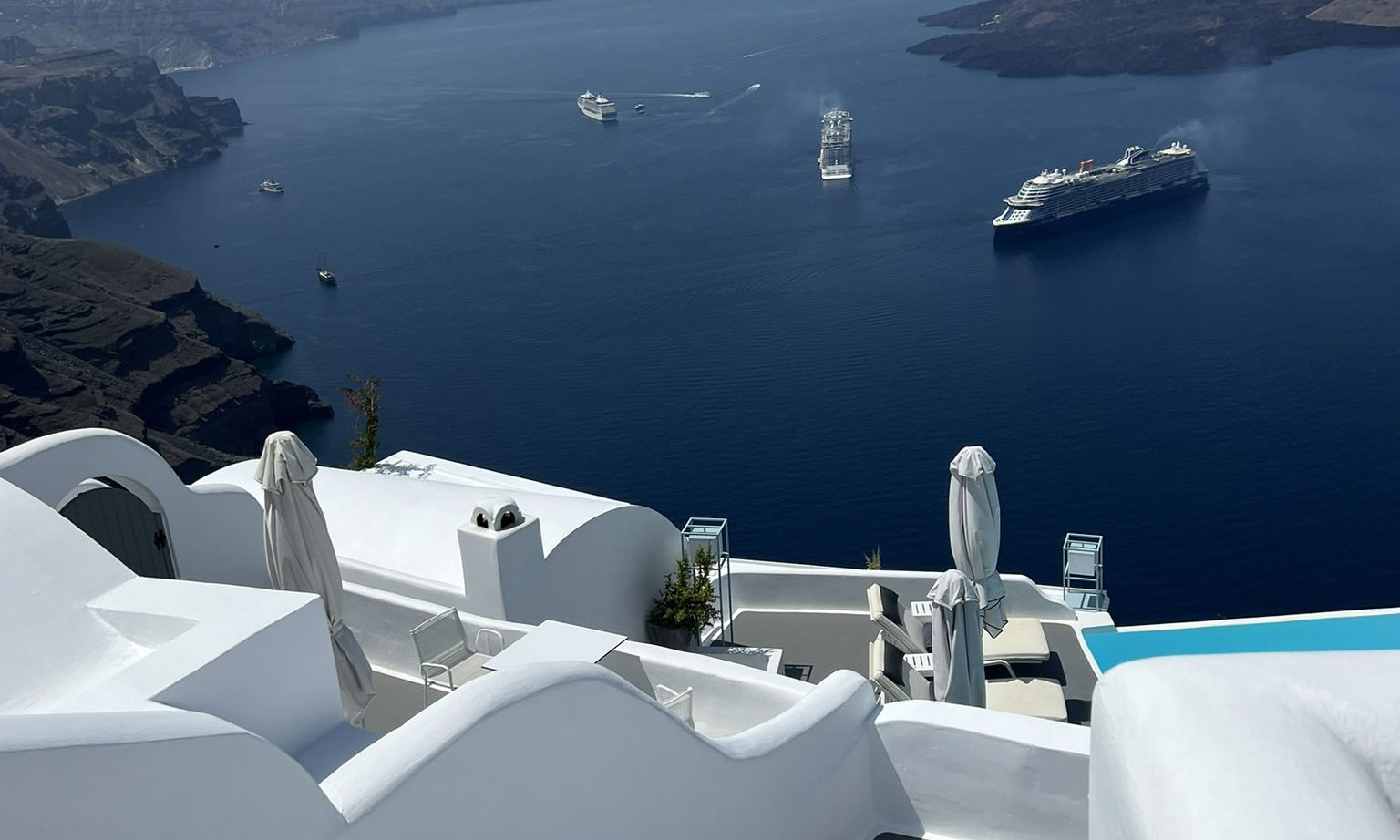
Santorini has no cruise berth. It never has. The island is the rim of a drowned volcano, the water in the middle is three hundred metres deep, and there is nowhere for a ship that size to tie up. So every one of you comes ashore on a tender boat. That much has always been true.
What is new — or rather, what is back — is where the tender is allowed to take you. This is the part people keep getting wrong, so let me be precise. The 70–30 split is not some invention of 2026. It is roughly how this island has always worked. Then the earthquakes came in 2025, a Joint Ministerial Decision temporarily pushed nearly all traffic to Athinios for safety, the cruise lines got a taste of a Santorini where their coaches met the tender directly — and they liked it. In June 2026 the Municipal Port Fund of Thira voted unanimously to put the old split back:
It is not a guideline. Cruise lines that do not comply face administrative fines, suspension of activities and criminal sanctions. The Port Fund says the allocation is about safety, congestion and keeping vehicle routes clear — it cited civil protection measures from the 2025 seismic crisis, the need to keep areas open for emergencies, and the fact that Athinios is also the island's working ferry and cargo port, which is quite enough for one pier to be doing.
All of that is true. And all of that is also not the real reason. So let me tell you the real reason, because our own officials have said it out loud and it has barely been reported outside Greece.
Why the rule exists — and why I agree with it
Here is what the President of the Santorini Port Fund, Georgios Nomikos, actually said. When cruise lines use the industrial port at Athinios, passengers are loaded directly onto the cruise lines' own tour buses — and Fira, the capital of this island, home to more than six hundred local businesses, is bypassed completely. Not reduced. Bypassed. His position, and the Municipality's, is that the island supports the cruise industry, but the economic benefit has to reach the local ecosystem rather than a select few corporate entities.
Think about what the Athinios model actually is, from the island's side of the counter. A ship anchors in our caldera. It tenders four thousand people to an industrial pier. They step off the boat, walk ten metres, and step onto a bus owned by — or contracted exclusively to — the company that brought them. That bus drives them around Santorini in a sealed loop. They look at us through a window. They are returned to the pier and re-boarded. And at no point in that entire day does a single euro touch a person who lives here.
Mayor Nikos Zorzos has gone further. He has pointed at an unauthorised development at Vlychada — an environmentally sensitive part of this island — where a cruise operator built a private, closed-gate tourist facility. His words, not mine: they created an exclusive enclave strictly for corporate profit, directly at the expense of Santorini's local economy.
The fight you are sailing into
This is not a polite disagreement. On 22 June 2026 the island's tour bus operators walked out in protest, and every scheduled cruise call that day was cancelled — MSC Sinfonia and Norwegian Pearl dropped Santorini outright, Celebrity Ascent pushed to the next day. Thousands of people woke up in the caldera, looked at this island through a window, and sailed past it. The Naxos First Instance Prosecutor's Office has asked for an investigation into the allocation; the Municipality and the Port Fund reject the criticism and say the rule follows existing Greek legislation and the Joint Ministerial Decree on tourist safety.
The accusations from our side are blunt. Zorzos says operators are actively trying to bypass Fira and redirect people toward Athinios and Ammoudi. He also says some ships hold passengers on board in the morning and then release them all at once — manufacturing the very bottleneck at the Old Port that is then photographed as evidence the rule has failed. Nomikos put it plainly: when CLIA publishes pictures of overcrowded docks, they are being deceptive.
I cannot prove the delayed-disembarkation claim and I am not going to pretend I can. But I can tell you that I have stood on that pier and watched a morning stay empty far longer than it should have, and then watched it turn into a wall of people in fifteen minutes. Make of that what you like.
And now I have to be honest against my own interest
The 70–30 rule is, operationally, a mess. I am not going to pretend otherwise and you would not believe me if I did. It has pushed thousands more people a day onto a cable car that cannot take them. The bus operators' union called it unfair and dysfunctional and said it arrived without time slots, parking or organised meeting points, and on that narrow point they are not wrong — the infrastructure is not ready for what the rule sends it. It has made my own mornings harder. It made an entire day of cruise calls vanish in June. It is madness on the ground.
And I agree with it anyway.
I run a company that would have an easier life if every ship tendered to Athinios and my vans met them at the pier. I still think the Port Fund is right. An island is not a backdrop you rent by the hour. If Santorini can only be visited in a way where none of the money reaches Santorini, then the visit is not worth having — and we would rather fix the mess than accept the alternative. — Where I stand, for the record
And I am not alone in this, whatever you read. When the buses walked out, the Association of Merchants and Professionals of Thira — the actual shopkeepers, the actual tavernas, the six hundred businesses — condemned the strike, not the rule. The Municipality says its recent meetings had produced no disagreement over the 70–30 quota itself. This is not an island against its visitors. This is an island arguing about who gets to keep the money you brought with you.
What the rule needs is not repeal. It needs time slots between the two ports, so four ships stop disembarking into the same ninety minutes. It needs parking and organised meeting points — the Municipality says it already funds parking at Oia and Fira to the tune of €72,000 a year, and it is plainly not enough. The Mayor and CLIA's regional director have now sat in the same room, with the Port Authority, the Nomikos Foundation and the Chamber of Commerce. Good. That is the conversation that should have happened in March.
In the meantime, you are arriving on Tuesday, and none of that will be fixed by Tuesday. So here is what it means for you.
What this means, in practice, for you
Strip out the politics and here is what it does to your morning.
- You probably do not get to choose. Seven in ten of you are going to the Old Port. That is not a preference you express at the excursion desk — it is a quota your ship has to hit.
- The Old Port has no road. None. There is no taxi rank, no bus stop, no car park, no way for anyone to drive to you. From that pier there are exactly four ways out: the cable car, roughly 600 steps up the cliff, a donkey, or a boat.
- The ship's coach tour is now a rationed product. Coaches can only load at Athinios. Athinios is capped at 30%. So the "we'll skip the cable car for you" bus tour — the one being sold on the app right now — is by definition available to fewer than a third of the people on your ship.
- Everyone else is funnelled into one cable car. Which is where the arithmetic gets ugly.
The arithmetic nobody on board has done
Santorini caps cruise arrivals at 8,000 passengers per day. Seventy per cent of 8,000 is 5,600 people, landing at a pier with no road.
The cable car out of that pier is rated at 1,200 people per hour in total — roughly 600 of them going up. In practice, running hard on a busy morning, it does a little better than that. It has six-person cabins, six cabins to a train, 220 vertical metres, three minutes a trip. And that figure has not meaningfully changed since 1982.
Read that last number again. It would take longer to move a capped day's passengers up that cliff than most ships are here for. That is not pessimism, it is division. And it assumes nobody is coming down, which they are, on the same cable, all afternoon — every person descending is a cabin not ascending.
Before the cap existed, peak days pushed 15,000 and touched 17,000 people ashore. So please understand — the cap and the rule are not the island being hostile to you. They are the island trying to survive a maths problem it did not create. But the rule does not make the cliff shorter. It just decides which side of it you start on.
And now the money, since we are being honest
You are in your cabin, browsing the excursion desk on the ship's app. A tour of Santorini — Oia, a viewpoint, a winery, back by 16:00. It costs, let us say, $180 per person. You book it, because it feels safe. The ship sells it, so the ship stands behind it.
Here is the part the excursion desk does not print. A very large share of that $180 never leaves the ship. The cruise line contracts a local operator and pays them a fraction of the ticket price — industry reporting puts the line's cut at up to half. Travel-trade coverage has long described shore excursions as one of the most fiercely protected revenue streams on board, and cruise lines have actively fought to stop passengers booking around them. Compare like for like and ship-sold tours consistently run 20–50% more expensive than the equivalent independent tour. And it does not stop at one layer: the contracted operator often subcontracts the driving to a third party, so by the time the money reaches the person holding the steering wheel on this island, it can be around a fifth of what you paid.
I want to be fair here. The cruise line is a business, it carried you across the Aegean, and it is entitled to a margin. I do not resent the margin. I resent what the margin does to your day.
When only a third of the money reaches the ground, the ground cannot afford to give you a good day. It can afford a fifty-seat coach, a twenty-minute photo stop, and a schedule written around parking spaces and diesel. That is not a Santorini problem. That is a maths problem, and you paid for it twice. — My honest opinion, after fifteen seasons of watching it
This is why the ship excursion so often feels thin. Nobody on the island is being lazy. The operator running your coach is working with what is left after the ship takes its share, and what is left buys volume, not quality. Fifty people on a coach at €40 of real budget each is a very different product from six people in a Mercedes with a guide who has all day for you.
The other thing they do not tell you: the tour bus does not fit
This is the part that genuinely annoys me, because it is not about money — it is about selling a product that does not physically suit the place it is sold for.
Santorini is a volcanic ridge with medieval villages built for donkeys. The roads in and around the caldera villages are narrow, single-lane in places, and built long before anyone imagined a fifty-seat coach. And yet the standard cruise-sold tour of this island is a fifty-seat coach — because a coach is the only vehicle that makes the economics work once the ship has taken its share.
Here is how that day actually goes, if you are one of the 30% who get it:
- You are tendered to Athinios, the working ferry port, because it is the only one with a road. It sits at the bottom of a switchback cut into the cliff on the wrong side of the island for everything you came to see. Grinding up out of it and across to Oia is a long, slow drive. The marketing calls this "convenient".
- The coach cannot enter Oia. No coach can. It parks outside the village and you walk. Uphill, in the sun, often the better part of a kilometre, before you have seen a single blue dome. Nobody mentioned that on the excursion page.
- You get roughly 45–60 minutes in Oia. Enough to walk in, take a photo in a queue of forty people, buy a magnet, and walk back out.
- Then you get back on the coach and grind back down to Athinios, and the day is over.
- And the headline that sold you the whole thing? "Skip the cable car."
That is the promise. Skip the evil cable car. It is presented as the villain of your Santorini day, the thing you are being rescued from. You are paying a premium, taking a long drive out of Athinios and then walking half a mile uphill into Oia — in order to be saved from a three-minute gondola ride with the best view on the island.
And now hold that next to the 70–30 rule, because this is the part that makes me put my coffee down. The bus tour needs Athinios. Athinios is capped at 30%. Which means the entire "we will rescue you from the cable car" pitch is a promise that, by law, cannot be kept for more than three passengers in ten. The other seven are going to the Old Port — where the cable car is, where the queue is, and where the thing they were told to fear is the only thing waiting for them.
One more detail that deserves a mention: some "skip the cable car" packages only skip it in one direction. Read your voucher. If it drops you in Fira at the end of the day, you are going down in that cable car anyway, at 17:00, in the worst queue of the day, with every other ship's passengers doing the same thing.
The cable car is not your enemy. It is one of the best things on this island.
I want to defend it, because the way it has been turned into a villain by marketing copy is genuinely unfair to Santorini.
Before 1982, there were two ways up this cliff from the Old Port: about six hundred steep steps, or a mule. That was it. If you were elderly, or had a bad knee, or a suitcase, the island was effectively closed to you. Then a Santorinian shipowner named Evangelos Nomikos set up a foundation in 1979 and paid for a cable car out of his own pocket, as a gift. Construction ran from 1980 to 1982. Doppelmayr built it. It has been carrying people up that wall ever since.
Today it belongs to the Municipality of Thera, and all fourteen communities of Santorini own it equally. A share of every ticket goes to the mule owners whose livelihood it displaced, and the rest goes back into charitable, educational and cultural projects across the island. Your €10 is not a toll. It is a donation to a village.
And as a ride, it is genuinely wonderful: 220 vertical metres, three minutes, the caldera opening underneath you, the tenders shrinking into the black water below. If you visit Santorini on a quiet day, or early, ride it. It is an attraction, not an obstacle. Treat it like one and buy your ticket online in advance so you are not standing at a cash-only window.
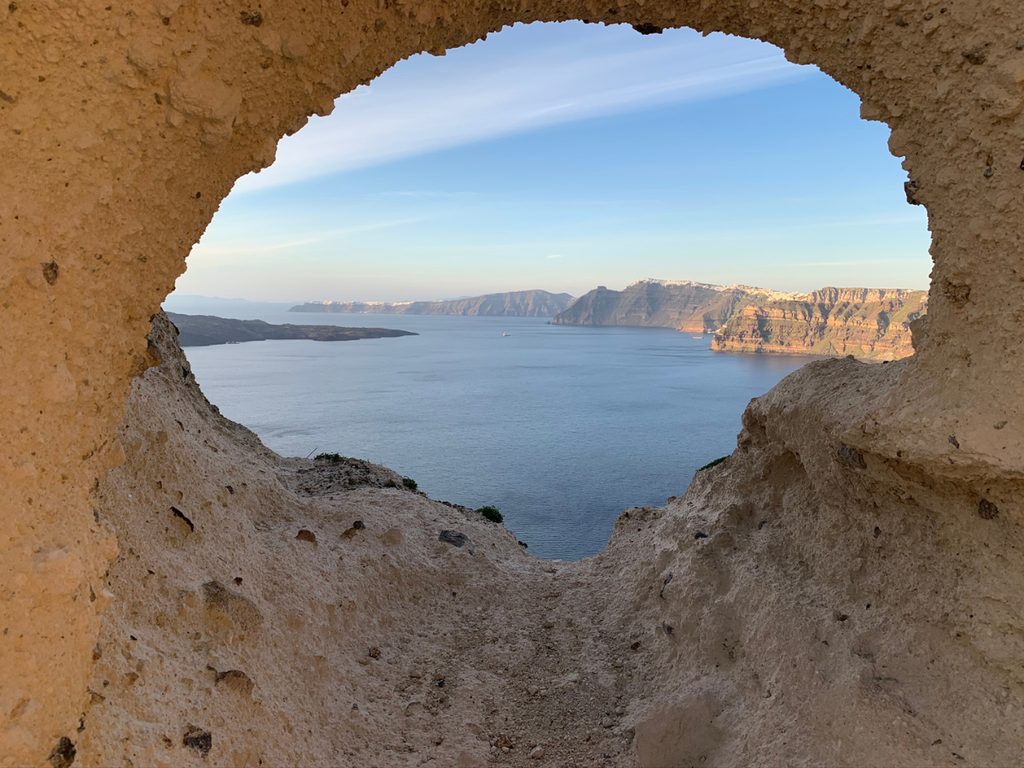
So it is not the villain. It is the bottleneck.
Those two words are not the same and the difference matters. The cable car is not badly run, it is not gouging anybody, and it has never once pretended to be something it is not. It is a 1982 machine, sized for 1982, that has just been handed 70% of every ship in the caldera by a rule written in 2026. Nobody asked it whether it could take that. Nobody asked the cliff either.
So when the excursion desk sells you a rescue from the cable car, understand what is actually being said: we will get you into the 30%, and the other seven hundred people on this ship can queue. That is not a solution to Santorini's problem. It is a queue-jumping ticket sold as a tour, and it is rationed.
The honest answer is not "the cable car is bad". The honest answer is: ride it when it is quiet, and when it is not, don't stand in a nine-hour queue — go around it by sea.
In the 70%? Leave by sea.
The rule puts you at the Old Port. It does not say you have to queue there. Our water taxi collects you on the same pier your tender lands on and takes you to Ammoudi Bay below Oia, or to Athinios — ports with roads, where your driver is already waiting. A coordinator with your name on a sign meets the boat. You never enter the cable car terminal, in either direction.
See the Water Taxi ServiceFour ships, one morning: what actually happens
Cruise itineraries are not coordinated with each other. Nobody sits in a room and staggers them. Ships arrive when the schedule and the previous port dictate, which means they overwhelmingly arrive in the same window: early morning, anchored in the caldera, tendering from around 07:00.
The result is that Santorini does not have a busy day. It has a busy ninety minutes, four times a day. Everything is calm, and then four thousand people arrive at one pier at once, and then it is calm again, and then everyone tries to leave at once at 17:00. If you have ever wondered why the island feels like chaos when the photographs look empty — that is why.
So here is what I would tell my own family if they were on your ship:
- Ask guest services one specific question: "which port am I being tendered to, and can I request the other one?" You may not get a choice — it is a daily quota, not a preference — but you will at least know which of the two days you are having before you land, instead of finding out at the pier.
- Get your tender ticket the moment they are released. Not after breakfast. The gap between the first and last tender group is routinely two hours. On a six-hour call, that is a third of your day gone before you have touched land.
- Do not queue for the cable car at 09:00 and again at 16:30. Those are the two worst hours of the day and they are entirely avoidable.
- Decide before you land. Standing at the Old Port improvising, surrounded by four thousand people doing the same, is the single most expensive mistake of the day — expensive in hours, not euros.
- Budget the €20. Greece's sustainable tourism fee charges cruise passengers €20 per person at Santorini and Mykonos in peak season, €12 in the shoulder months. It is not optional and it is not a scam — it goes to the island carrying you.
- Build in a buffer. Any operator who tells you they will have you back "just in time" is telling you they have no buffer. Ours is built into the route, not into optimism.
The water taxi: the way out of the Old Port that nobody sells you on board
Everybody arguing about the 70–30 rule — the Port Fund, the mayor, CLIA, the bus operators — is arguing about the same thing: how do you get people up. Up the cliff, up the switchback, up the cable car. And the whole argument misses the obvious.
You don't have to go up. You can stay on the water.
Your tender lands at the Old Port, exactly as the rule requires. Instead of turning left into the cable car terminal with five thousand other people, you turn right and walk to a boat. Twenty-odd minutes along the base of the caldera wall — which is, incidentally, one of the great short boat rides anywhere, straight past the cliffs everyone else is photographing from the top — and you step off at Ammoudi Bay, directly underneath Oia. Or at Athinios. Both have a road. Your driver is standing on it. Your day starts at minute twenty instead of minute ninety.
Let me deal with the obvious question, because I would rather answer it than have you wonder — and because I have just spent a thousand words telling you I agree with a rule that I am now proposing you sail around.
Is this bypassing Fira? No, and the distinction is the whole point. The 70–30 rule governs which port your tender may land you at. You are in the 70%. You disembark at Ormos Fira exactly as the Port Fund requires, and you are counted there. What you do next — boat, gondola, six hundred steps, donkey — is not what the rule is about. The Mayor's complaint concerns ships attempting to bypass Fira at the tendering stage, which is a different thing entirely from a passenger who arrived at Fira and then chose a boat over a queue.
But I will go further, because the legal answer is the boring one and you deserve the real one. The rule exists so that the money lands here. That is its purpose — Nomikos said so. So test us against the purpose, not the turnstile. Every euro of what you spend with us stays on this island: the boat is local, the coordinator is local, the driver is local, the guide is local, the taverna we take you to at lunch is somebody's family. Compare that to a pier-to-bus-to-pier loop where the money never gets off the ship. I am not the thing that rule was written to stop. I am closer to the thing it was written to protect.
And if you would rather ride the cable car up and walk into Fira and spend your morning in those six hundred shops — do that. Truly. That is the outcome my own municipality is fighting for, and I would rather you did that than took a bus to nowhere. Just do it at 09:00, not at 17:00.
Two honest warnings, because I would rather you hear them from me:
- The walk-up "water bus" is not the same thing. The public boat waits until it is full enough to be worth leaving, which can be an hour, and it lands you at Ammoudi with a shuttle bus to find. Cheap, and sometimes fine. But you have swapped one queue for another, and the pier at Ammoudi is jammed — a private car cannot always collect you there without an arrangement in place.
- Wind matters. This is the Aegean. On a meltemi day the crossing is bumpy and occasionally it does not run. Anybody who tells you the sea is guaranteed is lying to you. We will tell you the morning of, and we will have a land plan.
Done properly — a coordinator at the pier holding your name, a boat aligned to the tender times, a driver waiting on the road at the other end — it removes the two worst parts of your day completely.
Shore Excursion, Water Taxi Included
Designed for the seven in ten passengers the rule sends to the Old Port. Six hours of actual touring — the water taxi and tender transfers sit outside that clock, not inside it. A coordinator meets you on the pier, the boat takes you to a port that has a road, and your driver and guide start there. No cable car in either direction. On-time return, with a buffer written into the route rather than hoped for.
- Old Port pickup with a named sign
- No cable car, either direction
- Private Mercedes & local guide
- 6 hrs touring, transfers on top
- On-time return guaranteed
Now the part I actually care about: you are judging an island from one balcony
Santorini is 76 square kilometres with about fifteen and a half thousand people living on it. Somewhere between three and three and a half million visitors come every year. Those numbers are genuinely difficult, and I am not going to pretend the island has no pressure — it does, and the cap and the fee exist for real reasons.
But look at where the crowd actually is. It is in one village. In fact it is in about four hundred metres of one village — the lane above the blue domes in Oia, and the castle at the end of it — between about five and eight in the evening. That is the photograph. That is the viral video of people packed shoulder to shoulder. That is the entire evidentiary basis on which the world has decided Santorini is finished.
An island of seventy-six square kilometres has been convicted on the evidence of four hundred metres, at one hour, in one season. If you judged Paris by the queue at the Mona Lisa at midday in August, you would conclude France was uninhabitable. — The thing I most want cruise passengers to understand
I wrote a longer piece about this, because it deserves more than a paragraph: the misguided criticism of Santorini and overtourism. The short version is that Santorini does not have too many visitors so much as it has all of them in the same fifty metres at the same forty minutes, and that is a distribution problem, not a capacity problem — and it is entirely solvable at the level of one individual day. Yours.
Because at 18:30, while eight thousand people are compressed into that lane in Oia, I can put you on a terrace in Pyrgos looking at exactly the same sunset over exactly the same caldera, with about nine other people and a glass of Assyrtiko. Same island. Same evening. Same sun. Different four hundred metres.
All of this is also Santorini
Every photograph below was taken on this island, on a day the blue domes were gridlocked. None of them are in Oia. None of them were crowded.
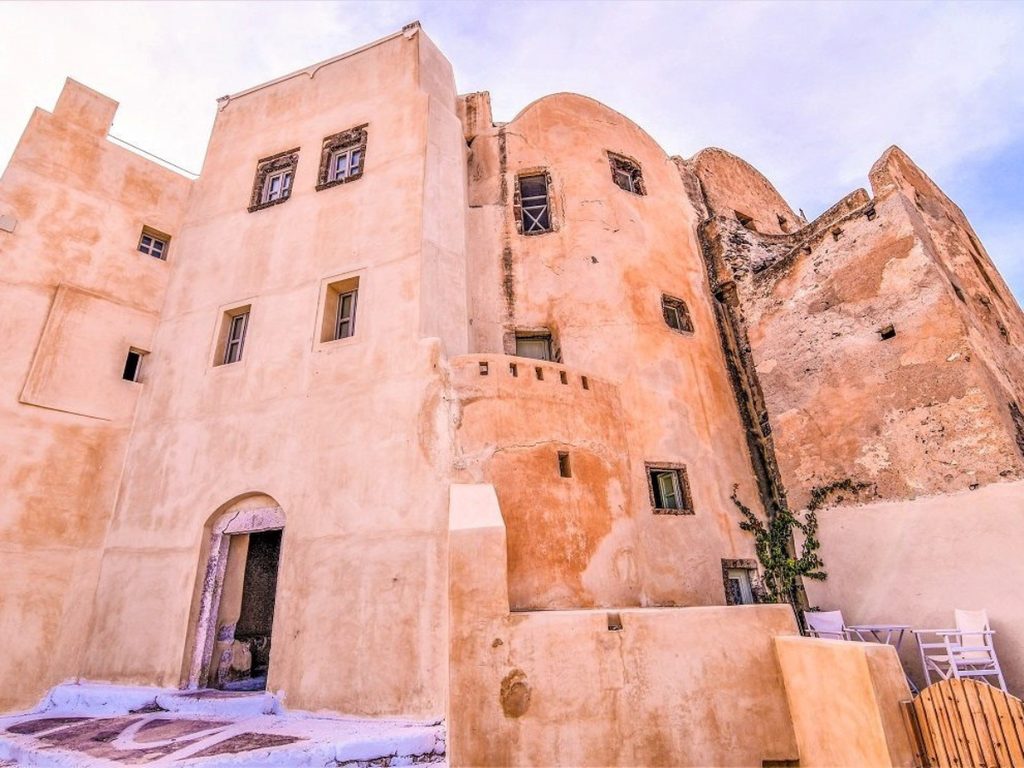 Kasteli, Pyrgos — the Venetian castle quarter
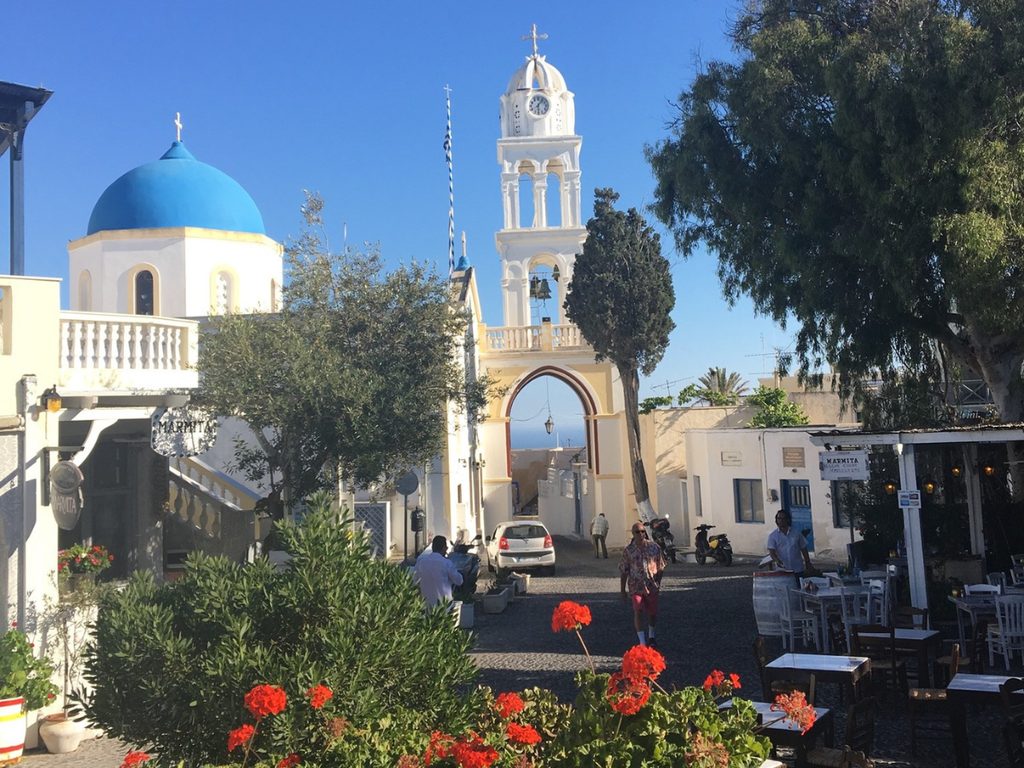 Megalochori square, on a normal afternoon
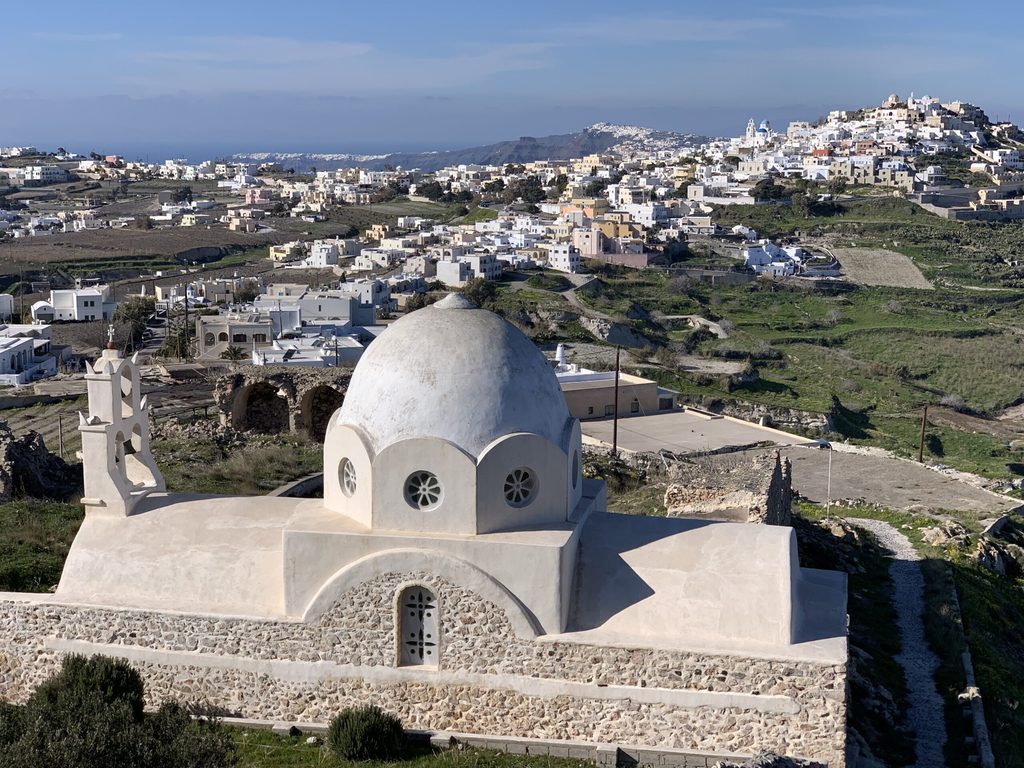 A chapel nobody queues for
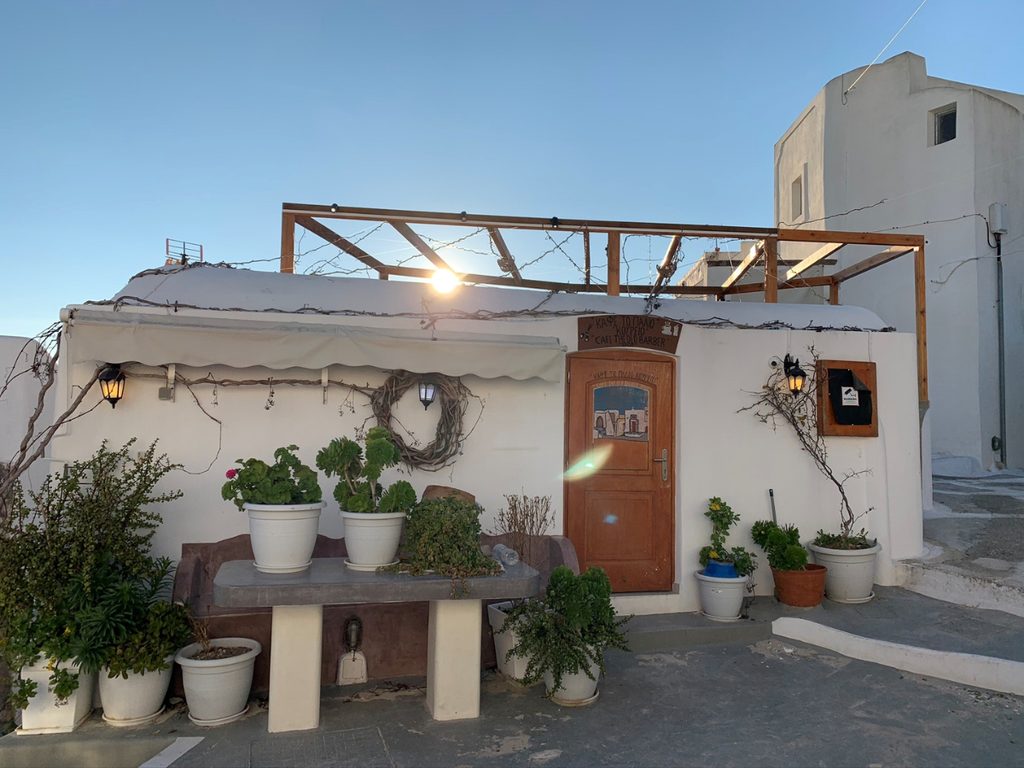 The old barber's cafe, Emporio
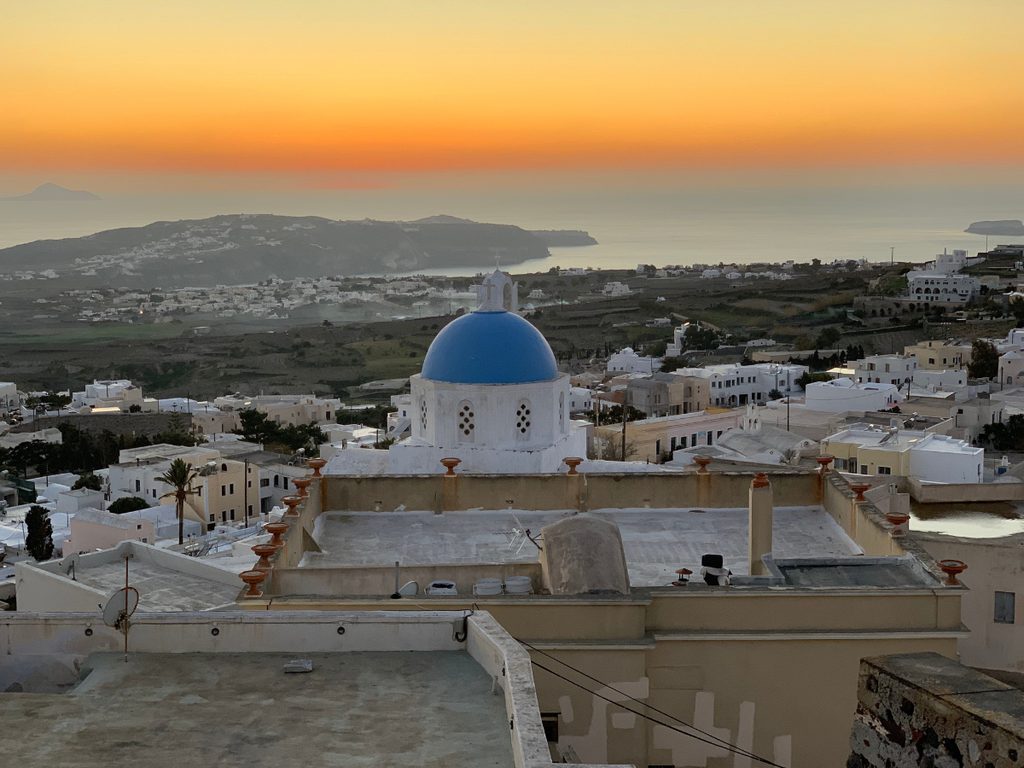 Sunset from Pyrgos — the same sun as Oia
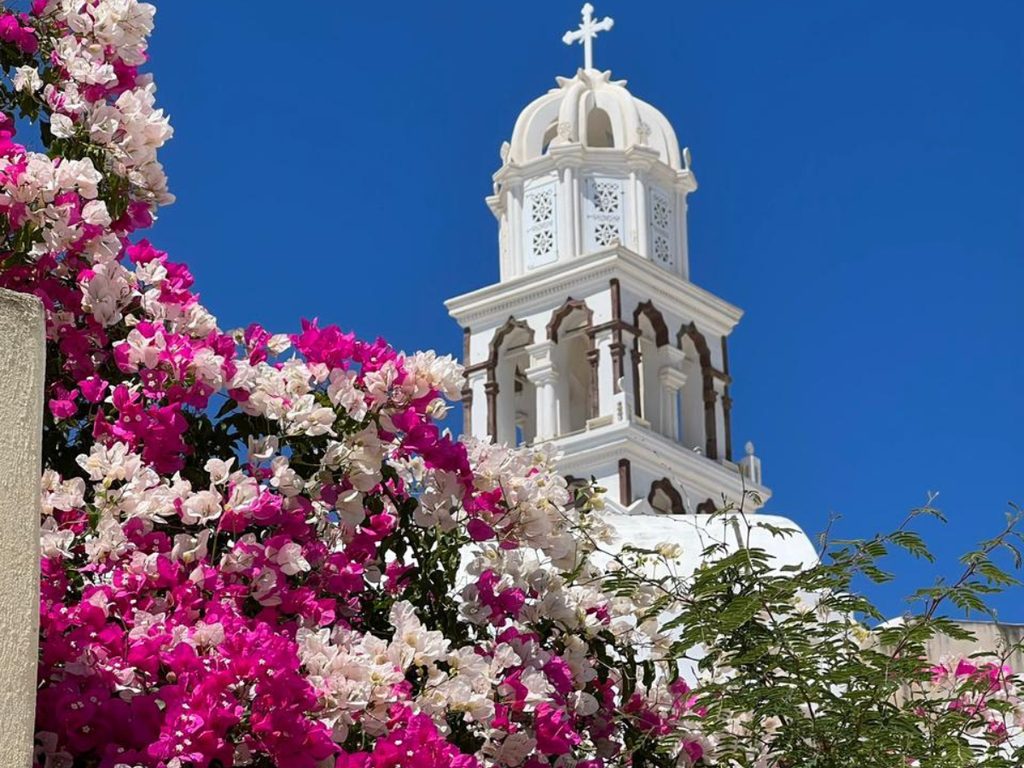 Bougainvillea, and no tripods
 A vineyard, and time to stand in it
The caldera, without the balcony rail
A vineyard, and time to stand in it
The caldera, without the balcony rail
"Just see Oia" versus a full day: an honest comparison
A lot of cruise passengers arrive having decided that the goal of the day is Oia. I understand why — it is what the algorithm showed you. But let me put the two days side by side, honestly, including the case for going to Oia and nothing else.
I will say the quiet part: if your ship is only here for four hours, go to Oia and enjoy it. Take the cable car, get a bus or a taxi, have your coffee on a caldera terrace, take the photograph, come back. That is a legitimate day and I am not going to pretend it is a tragedy.
But if you have eight hours and you spend six of them queueing to look at one village that you will share with four thousand people — that is the tragedy. That is the day that produces the review saying Santorini is overrated. And it is not Santorini that was overrated. It was the itinerary.
If Oia is what you want, read our full guide to Oia first and go at the right hour, from the right direction, on foot from the right end. It is still, genuinely, one of the most beautiful villages in the Mediterranean. It just is not the whole island, and it is not at its best at 18:45 in August.
What I would actually do with your day
Before the itinerary, the thing people get wrong constantly. There are two clocks, and they are not the same clock.
This matters more than anything else on this page. The gap between those two clocks is the entire game. Tender plus water taxi is about forty minutes and you spend it on the water looking up at the cliffs. Tender plus a cable car queue on a four-ship morning is ninety minutes or more — and then the same again coming back. That is three hours of your ship's clock, spent standing still, that buys you precisely nothing. Same six-hour tour either way. Completely different day around it.
Before the tour clock starts
- First tender. Non-negotiable. Skip the buffet, get the ticket the moment they are released.
- Old Port, turn right. Water taxi, not the cable car queue. Twenty-odd minutes along the base of the caldera wall — one of the best short boat rides in Greece, and it happens to also be your transfer.
- Ammoudi. Coordinator, then your driver on the road above. Now the six hours begin.
The six hours you actually bought
- 0:00 — Oia, while it is still half empty. 09:30 in Oia is a completely different village from 18:30 in Oia. Same lanes, same domes, a tenth of the people. This alone is worth the early tender.
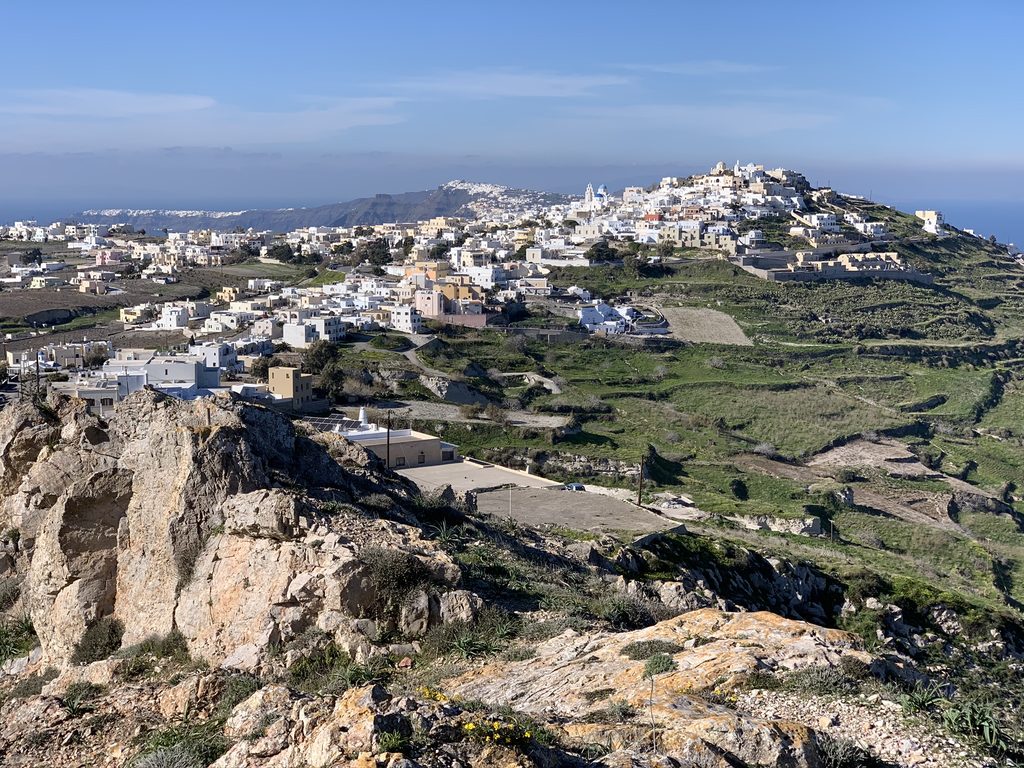
- 1:15 — Out of Oia and straight down the island's spine. Pyrgos — the Kasteli, the highest point on Santorini, the whole island underneath you and nobody else on the wall.
- 2:30 — Megalochori, and a winery. They are neighbours, which is not a coincidence — this is the vineyard belt. Assyrtiko grown in baskets on the ground because of the wind. Vinsanto. Sat down, unhurried, not a coach queue at a tasting counter.
- 3:30 — The volcanic south. Red Beach, the Akrotiri lighthouse, or the volcanic beaches. This is the side of Santorini nobody photographs and everybody remembers.
- 4:30 — Lunch somewhere with a Greek menu on the wall, in a village whose name you had not heard this morning. Not a scheduled "refreshment stop" at somebody's cousin's shop.
- 5:30 — Back toward the port, by road and boat, with a real buffer built into the route.
Six hours of Santorini instead of six hours of Santorini minus three hours of queue. That is the whole argument. It is not a longer day — it is the same day with the dead parts removed.
One last thing, and then I will stop
The people who live here are not tired of you. That is the thing the "overtourism" headlines get wrong about Santorini specifically. This island has been welcoming ships since it was a volcano with a harbour in the middle of it, and the hospitality here is real, not performed.
What we are tired of is the shape of the day: four thousand people compressed into one pier at 08:00, one lane at 18:30, and one cable car at 17:00, all being told the whole time that the island is a disappointment. You are not a burden. The schedule is a burden. And the schedule is the one thing you actually have some control over.
So take the early tender. Go around the queue instead of standing in it. Look at the four hundred metres everybody photographs, and then go and look at the other seventy-six square kilometres. And ride the cable car at least once, at a quiet hour, because a man from this island paid for it out of his own pocket so that you could.
Sources & further reading
- Greek Reporter — Nomikos and Zorzos on the 600 bypassed businesses, the Vlychada enclave, and why the split was reinstated
- Cruise Industry News — Santorini implements new cruise tender limits (30% Athinios, down from 40%)
- GTP Headlines — the bus operators' case: "unfair and dysfunctional", no time slots, no parking, no meeting points
- Greek City Times — the Merchants and Professionals of Thira condemning the strike, and the Municipality's response
- Cruise News — the 70–30 allocation, sanctions, the prosecutor's investigation, and the Port Fund's response
- Greek City Times — the 22 June 2026 bus operator strike and the cancellation of every cruise call that day
- Travel Weekly — on shore excursions as a protected cruise-line revenue stream
- Ship vs. independent shore excursions — pricing differential and commission structures
- Seatrade Cruise News — Greece's sustainable tourism fee, tiers and implementation
- Santorini Cable Car — Nomikos Foundation, Doppelmayr, capacity and community ownership
- Official cable car e-tickets — buy in advance, avoid the cash-only window
How we do a cruise day differently
We are a local company on this island. We are not a call centre, we are not reselling you a coach seat, and we do not have a cruise line taking a cut of your money before it reaches us.
No Cable Car, Either Way
Our water taxi takes you from the Old Port to Ammoudi Bay or Athinios — road-accessible ports where your driver is already waiting. Not one direction. Both.
Built Around Your Tenders
We track your ship, we know the tender pattern, and the route is written backwards from your all-aboard time with a real buffer. Shore excursions designed for cruise timing, not adapted to it.
Vehicles That Fit The Roads
Mercedes cars and vans, not fifty-seat coaches on medieval lanes. That is not luxury for its own sake — it is the only size that can actually reach the places worth reaching.
The Whole Island
Oia when it is quiet, and then Pyrgos, Megalochori, Emporio, the vineyards, the volcanic south. The Highlights of Santorini tour, at your pace.
Your Money Stays Here
You book us directly. There is no cruise line taking up to half off the top before it reaches the island, which is precisely why we can put six of you in a Mercedes with a guide instead of fifty of you on a coach.
We Will Tell You The Truth
If the meltemi is blowing, we say so and switch to land. If your call is too short for a full day, we will tell you to take the cable car and enjoy Oia. We would rather lose a booking than sell you a bad day.
Cruise passenger questions we get every week
What is Santorini's 70–30 rule?
Since June 2026, the Municipal Port Fund of Thira requires up to 70% of each cruise ship's passengers to come ashore at Ormos Fira — the Old Port below Fira — with no more than 30% tendered to Athinios. It restores the split that applied before the 2025 earthquakes temporarily pushed almost all traffic to Athinios, cutting the interim 40% share back to 30%. It is calculated daily and has no expiry date. Non-compliance carries administrative fines, suspension of activities and criminal sanctions. Because Athinios is the only port with road access for coaches, the rule effectively rations ship-organised bus tours to under a third of the ship.
Why did Santorini bring in the 70–30 rule?
Officially: safety, congestion, emergency access, and relieving Athinios, which is also the island's working ferry and cargo port. Actually: money. The President of the Santorini Port Fund has said that when cruise lines use Athinios, passengers step straight onto the lines' own tour buses and Fira — the capital, with over 600 local businesses — is bypassed completely. The Municipality's position is that the island supports cruise tourism, but the benefit has to reach the local ecosystem rather than a select few corporate entities. For what it is worth, we agree with them, and we have said so above.
How does the 70–30 rule affect my day in Santorini?
If you are in the 70%, your tender lands at the Old Port, which has no road access at all. From there the only ways up are the cable car, roughly 600 steps, a donkey — or a boat. On a capped 8,000-passenger day, 70% is 5,600 people arriving at a port whose cable car lifts about 600 an hour upwards. That is eight to nine hours of queue if everyone used it — longer than most calls last. The practical answer is to leave the Old Port by sea instead — a water taxi to Ammoudi Bay or Athinios, where a road and a driver are waiting.
Can I choose which port my tender goes to?
Generally no. It is a quota your ship must hit, not a preference you express. Ask guest services which port you are allocated to — knowing before you land is worth more than arguing about it at the pier. If you are in the 70% going to the Old Port, plan for a port with no road: cable car, roughly 600 steps, a donkey, or a boat.
Does taking a water taxi break the 70–30 rule?
No. The rule governs where your tender may land you, not how you travel afterwards. You disembark at Ormos Fira as required and are counted there; leaving that harbour by boat instead of by cable car is not bypassing anything. The dispute the Mayor of Thira has raised concerns ships attempting to bypass Fira altogether at the tendering stage.
How do I skip the cable car queue in Santorini?
Take a water taxi from the Old Port — the same pier your tender lands on — to Ammoudi Bay below Oia, or to Athinios. Both are reachable by road, so a private driver can meet you. Arranged in advance with a coordinator at the pier, you never enter the cable car terminal in either direction. The walk-up public "water bus" is cheaper but waits until it is full and leaves you to find a shuttle at the other end.
Should I book the excursion through my cruise ship or independently?
Ship-sold tours run roughly 20–50% more than the equivalent independent tour, because a large share of the price — up to half, by industry reporting — stays with the cruise line. The ship's real advantage is that it waits for its own tours. A local operator who builds the day around your tender times and writes a buffer into the route gives you the same protection, in a vehicle that fits the roads.
How many hours do I actually get ashore?
Ships anchor for six to ten hours, but you lose the front to tender tickets and the back to the queue down. Plan for four to eight usable hours. Get an early tender number the moment they are released — the gap between the first and last group is routinely two hours. Keep the two clocks separate: our six-hour tour is six hours of touring, and the tender and water taxi transfers sit outside it rather than eating into it.
Is the Santorini cable car worth it?
Yes — at a quiet hour. It is 220 metres and three minutes with the best view on the island, it was donated to Santorini by the Nomikos Foundation and built in 1980–82, and it is owned equally by all fourteen communities, with a share of every ticket going back to the island. Buy tickets online in advance. The problem is never the ride; it is that a 1982 machine moving about 600 people an hour uphill cannot absorb four ships arriving together.
Do cruise passengers pay a tax in Santorini?
Yes. Greece's sustainable tourism fee is €20 per cruise passenger at Santorini and Mykonos in peak season, €12 in the shoulder months, and less in low season; other Greek ports charge considerably less. Santorini also caps cruise arrivals at 8,000 passengers per day, and from 2026 that cap counts ships at full capacity rather than an assumed load factor.
Is Santorini actually ruined by crowds?
No — it is congested in about four hundred metres of one village between roughly 17:00 and 20:00. The island is 76 km². Pyrgos, Emporio, Megalochori, Akrotiri, the vineyards and the eastern coast are calm on the same day the blue domes are gridlocked. We wrote about this at length in the misguided criticism of Santorini and overtourism.
What happens if the sea is rough?
The meltemi is real and on some days the boat does not run. We tell you the morning of, and we switch to a land plan. Any operator who guarantees the Aegean is not being straight with you.
Tell us your ship and your date
Send us the ship, the port date, and how many of you there are. We will tell you honestly what is realistic in your window — including if the answer is "just take the cable car and enjoy Oia".